


Institutional issues loom larger than the presidency

CenPEG Fellow Delivers Talk at Johns Hopkins U’s SAIS
By CenPEG.org
Nov. 15, 2012
President Benigno S. Aquino III faces formidable institutional challenges raising questions whether he can fulfill his election promises before he steps down in June 2016.

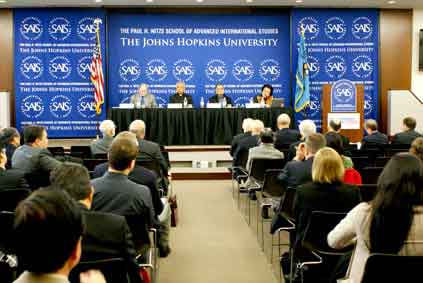
Bobby M. Tuazon, CenPEG’s Director for Policy Studies, made this assessment in his talk at the Johns Hopkins University’s School of Advanced International Studies (SAIS) in Washington, DC, Nov. 1 this year. Tuazon was invited to speak at the Nov. 1 SAIS symposium by the DC-based U.S.-Philippine Society.
In his talk at the panel on governance, Tuazon said Aquino III began his term in 2010 with the formation of a Truth Commission that was tasked to investigate corruption charges against former President Gloria M. Arroyo. However, the first step at coming up to his anti-corruption election promise suffered a setback when the commission was shot down by the Supreme Court (SC) on a petition by Arroyo’s lawyers.
Aquino III then challenged the SC – which was packed with Arroyo appointees – by having its chief justice, Renato Corona, impeached allowing his own appointee, Associate Justice Sereno, to take his place.
Last October, the Philippine president announced the signing of a framework of agreement with the rebellious Moro Islamic Liberation Front (MILF) setting in place a final peace agreement and an autonomous “self-governing” Bangsamoro ministerial government.
Despite his much-touted accomplishments, Aquino has been sending mixed signals and inconsistencies that raise doubts about his ability to govern according to his election agenda, Tuazon observed. His support for pork barrel allotments for Congress and his lack of will in pushing for the enactment of the Freedom of Information (FOI) bill leave his anti-corruption platform as a mere political gimmick, he said. His claim of good governance is refuted by his tacit support for the much-denounced system of political dynasties by endorsing the senatorial candidacy of Bam Aquino, a cousin. Another blood relative is running for senate under the opposition coalition United Nationalist Alliance (UNA).
Tuazon said that the country’s institutional problems loom larger than the presidency – or changes in the presidency. The nation will be in a far better shape when its future relies less on the president and more in undertaking institutional reforms collectively, Tuazon told his audience.
The speakers in the one-day symposium included Kurt M. Campbell, Assistant Secretary of State for East Asian and Pacific Affairs; Jose L. Cuisia, Jr., Philippine ambassador to the U.S.; and former U.S. Ambassador to Manila and former Deputy Secretary of State John Negroponte.
Aside from Tuazon, the panel on governance included Philippine Defense Undersecretary Pio Lorenzo F. Batino and Rev. Fr. Benigno P. Beltran, SVD. The panel was chaired by Prof. Bernarditta Churchill. CenPEG.org


Comments