


US-Israel armed aggression on Iran is a huge failure

Updated: Jul 5
Issue Analysis No. 03 Series of 2026
Prof. Romulo M. Tuazon
Director for Policy Studies
Center for People Empowerment in Governance July 4, 2026
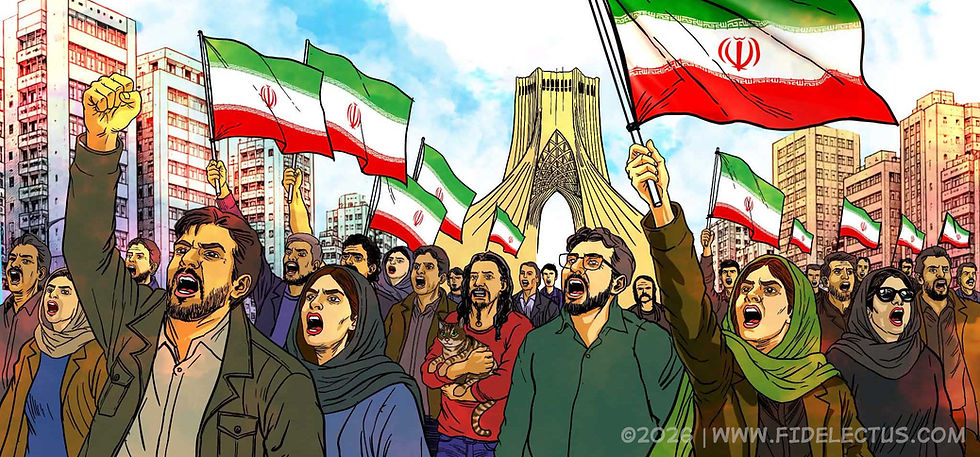
The war on Iran was originally a project of Israeli Prime Minister Benjamin Netanyahu that would be backed later by US President Donald Trump. While Iran suffered severe military and economic losses during the armed conflict, the Tehran government achieved a major geopolitical victory. It prevented the US and Israel from achieving their primary objectives - regime change/decapitation or the elimination of the country’s top leadership, and the total dismantlement of its nuclear and missile programs.
Netanyahu’s project
The US-Israeli war on Iran has had two stages: The first - the 12-day war - took place in June 2025. The 12-day escalation began when the Israeli Air Force launched a surprise attack on Iran targeting its nuclear scientists and program. Staged in February 2026, the second, “Operation Epic Fury”, was a coordinated joint campaign of massive air strikes by the United States and Israel across Iran.
The war against Iran and its regional allies was fundamentally Israeli Prime Minister Benjamin Netanyahu’s project. For decades, the PM “championed” a hardline doctrine arguing that a nuclear-armed Iran constitutes an existential threat to Israel’s survival. The raison d’etre was fabricated: Iran’s former Supreme Leader Ayatollah Ali Khamenei opposed the development of nuclear weapons. His stance was rooted in an Islamic religious decree, fatwa, that declared the production, stockpiling, and use of weapons of mass destruction to be forbidden (haram) under Islamic law.
The real motive behind Netanyahu’s project was rooted in Iran’s growing regional influence as well as the failure of international diplomacy to renegotiate nuclear agreements. The February strikes were unleashed on the pretext that diplomacy had been exhausted and that a “nuclear-armed Iran posed an unacceptable threat.”
Netanyahu and Israeli officials used armed attack to “permanently dismantle Iran's nuclear infrastructure and ballistic missile capabilities.” The Israeli prime minister also sought to cut off the funding, weapons, and direction that Iran provided to militant groups like Hamas in Gaza and Hezbollah in Lebanon.
Aggressively lobbying the United States, Netanyahu ultimately persuaded Trump to execute a joint military campaign, aiming to force regime change or at least secure strict long-term concessions from Tehran.
Like a prairie fire
Unleashed in February 2026, the US-Israel war against Iran blazed like a prairie fire, until recently. The American Empire’s aggression against Iran was defined by massive joint airstrikes - 900 strikes in the first 12 hours - topped by the Israeli-Mossad drone assassination of Supreme Leader Ali Khamenei with key military and suspected nuclear infrastructure left a shambles.
The treacherous attack on the supreme leader paralyzed the Iranian leadership for a while until a successor could be named.
The war also saw heavy regional fighting, naval blockades, and a tense 108-day campaign culminating in late-June diplomatic talks between Iran and the US.
In retaliation for the US-Israel attacks, the Tehran government struck US/allied bases across the Gulf – including those in Saudi Arabia, Bahrain, Lebanon, Iraq as well as shipping lanes in the Strait of Hormuz, causing severe global trade and energy disruptions.
Following failed April ceasefire bids hosted by Islamabad and ongoing naval blockades, hostilities eventually paused in May. By late June, the US negotiated a Memorandum of Understanding (MoU) with Iran aimed at ending the war. The accord called for unfreezing billions in Iranian assets and permits oil exports in exchange for dismantling ballistic missiles and capping the nuclear program.
The deal, however, sparked a political controversy in Israel.
The Israeli military campaigns led by Netanyahu began in October 2023, following the unprecedented attacks by Hamas-led groups on southern Israel. The Israeli military responded by launching a genocidal mass air campaign and a scorched-earth siege on Gaza.
Natanyahu’s war crimes and crimes against humanity prompted South Africa to institute proceedings in December 2023 against Israel at the International Court of Justice (ICJ) or the UN World Court accusing Israel's military actions in Gaza amounted to violations of the Geneva Convention. In November 2024 the Hague-based International Criminal Court (ICC) issued arrest warrants for Netanyahu and former Defense Minister Yoav Gallant for alleged war crimes and crimes against humanity, including using starvation as a weapon of warfare.
The case against Israel remains active.
Till now, the strategic Strait of Hormuz is a major flashpoint. Tensions spiked anew in late June when Iran closed the strait and struck a vessel in the area, leading to swift retaliatory US strikes on Iranian radar and missile facilities.
Iran’s Strait of Hormuz is a crucial, narrow sea passage in the Middle East that connects the Persian Gulf to the west with the Gulf of Oman and the Arabian Sea to the east. It separates Iran on the northern coast from the Musandam Peninsula of Oman on the south.
The strait is the world's most critical oil transit chokepoint, with about 20 percent of global petroleum consumption passing through its narrow waters. This volume translates to roughly 20–21 million barrels of crude oil and petroleum products passing through the strait daily.
Also in June, the US-Israel war on Iran saw a transition from major combat operations to tense brinkmanship, centered heavily on the Strait of Hormuz and diplomatic negotiations. Digitally signed on June 17, the 14-point MoU between Iran and the US aimed at, among others, bringing an end to hostilities in 60 days, the release of frozen funds, the reopening of the critical Strait of Hormuz to commercial traffic while the US will lift its naval blockade of Iranian ports with both sides negotiating the terms of a final deal on nuclear weapons and materiel.
Standdown for now
By June 28-29, the US and Iran agreed to pause kinetic strikes and enter into technical negotiations in Doha, Qatar, to resolve the disputes over vessel safety in the Gulf waterway. Further, the US will also work with regional partners to develop a $300 billion reconstruction account for Iran. Iran rejected the proposal.
Iranian victory signals end of US imperialism
Iran suffered severe military and economic losses during the recent conflict, but regional and strategic consensus suggests Tehran achieved a major geopolitical victory. Iran prevented the US and Israel from achieving their primary objectives - regime change and the total dismantlement of its nuclear and missile programs.
How do we explain all this?
Despite intense US and Israeli air campaigns that devastated its conventional military assets and killed top leadership, Iran’s core Islamic Republic structure remained intact. Surviving a direct confrontation with a global superpower is largely viewed as a strategic win in the region.
Iran’s successful contestation of US naval dominance in the Persian Gulf - forcing aircraft carriers to retreat and seizing operational leverage over global energy chokepoints especially the Strait of Hormuz - served as its most potent instrument of power during negotiations.
Iran successfully negotiated an interim memorandum of understanding with the United States that bypassed Israeli security demands, avoided firm limits on its "Axis of Resistance" proxy network, and provided access to frozen Iranian funds.
Iran’s victory over the superpower US signals the decline of the American Empire along with its hegemonic ambitions.
Now how to explain Iran’s victory in military terms?
Iran operates heavily through its "axis of resistance" - a decentralized network of proxy militias and non-state actors that project Iranian power from Yemen to Lebanon. The constitutional and democratic republic emerged from the recent conflict having preserved its deterrence and gained notable bargaining power, largely by forcing its adversaries into costly, protracted engagements. Tehran retains the ability to bypass direct conventional warfare by mobilizing proxies, producing and launching drone swarms, and threatening critical global energy infrastructure and freedom of navigation through the Strait of Hormuz.
In sum, regime change became a formalized objective for the United States and Israel following the 1979 Islamic Revolution viewing the latter as an existential threat to US-Israel hegemony in the region. Their goals expanded to dismantle Iran's nuclear capabilities, degrade its missile and drone programs, and reduce its regional influence.
The joint objective failed miserably; American power has been written off.
Iran, a 7,000-year civilization, is a highly institutionalized theocracy with layered security apparatuses, such as the Islamic Revolutionary Guard Corps (IRGC). There has been no significant splintering of elite loyalty, even under severe military pressure.
Too, Iran’s vast, mountainous terrain makes ground invasions highly costly. The country recalibrated its defense doctrine to prioritize asymmetric entrenchment, ensuring that its retaliatory capacity - such as ballistic missiles and drones - survived targeted campaigns.
Iran maintains critical economic and diplomatic support from countries like China and Russia, complicating imperialist efforts to completely isolate or overthrow the state. Iran’s victory deepens the security partnerships involving China, Russia, Iran, South Africa, and other Global South countries.
Finally, the conflict with Iran unveils once more the limits of American hegemony. Rather than a decisive victory, the US struggled to achieve its primary objectives which led to a costly, drawn-out conflict. The sustained use of advanced munitions (such as Tomahawk missiles, Patriot, and THAAD interceptors) heavily drained US military stockpiles, raising doubts about Washington's ability to respond to crises in other regions.
While some geopolitical analysts view these developments as a definitive sign that unipolar American dominance is ending, others argue that it instead reflects an era of imperial overstretch and a shift toward a multipolar global order. The ongoing diplomatic and technical negotiations in Qatar underscore these complex geopolitical realities.
As an overview, the war on Iran can be seen through the lens of the Thucydides Trap - a structural pattern where an established power's fear of a rising competitor's growing influence makes war highly likely. In the context of the recent US-Israel operations against Iran, the theory explains how pre-emptive anxieties about Iran's "ring of fire" and nuclear program dragged the alliance into a costly conflict.
The US-Israeli alliance entered the war based on the assumption that a short, sharp blow would collapse the Iranian state or neutralize its influence. The lesson is that decision-makers must never mistake operational posturing for permanent strategic prudence.
Iran’s military success can be explained further by looking at the philosophical foundation of its governance system which rests on Wilayat al-Faqih (Guardianship of the Islamic Jurist), a doctrine developed by Ayatollah Ruhollah Khomeini. The doctrine merges Twelver Shia Islam with republican elements, asserting that supreme political and religious authority should be held by a qualified Islamic jurist in the absence of the Hidden Imam.
The governance framework balances this theocratic foundation with structured democratic institutions in distinct ways. As head of government, the President is directly elected by the people every four years, primarily responsible for domestic policy and day-to-day administration. The Parliament (Majlis) is a 290-member elected legislative body responsible for drafting statutes, ratifying international treaties, and approving the president's cabinet.
Philippines
Insofar as the Philippines is concerned, the Ferdinand Marcos Jr. administration navigated overlapping crises as Middle East tensions triggered oil shocks and inflation, prompting the government to downgrade its 2026 GDP growth targets to 3.5 percent - 4.5 percent. On the domestic front, distracting political noise and impeachment proceedings complicated the administration's fiscal planning.
Specifically, the conflict in Iran and broader Middle East tensions heavily disrupted the Philippines' energy supply, as the country imports up to 98 percent of its crude oil directly from the Middle East including Saudi Arabia, UAE, Kuwait, Qatar and Iraq.
Lacking domestic oil production and relying on foreign refineries that depend on the Persian Gulf, the Philippines is highly vulnerable to Middle East oil imports and price fluctuations. This dependency exposes the country to severe supply chain disruptions and imported inflation whenever geopolitical tensions restrict shipping through the Strait of Hormuz.
The Philippines produces oil, but in very small quantities. The country generates about 14,345 barrels each day (BPD) and extracts a fraction of national demand from tiny domestic sites like the Galoc and Alegria fields.
All these have caused a spike in domestic inflation, leading economic managers to forecast average inflation of 6 percent – 7 percent for 2026.
For the Philippines, Middle East conflicts impact majority of Filipino families whose breadwinners are Overseas Filipino Workers (OFWs) working in Iran, Israel and other Gulf countries. OFWs bring in a record US$40B (or PhP2.3T) each year in personal remittances. These remittances historically account for about 8.5 percent to 10 percent of the country's Gross Domestic Product (GDP).
While the Philippines continues to face formidable economic challenges arising from the Middle East conflicts, domestic politics has been excessively focused on the impeachment of Vice President Sara Duterte and the roller-coaster, conflict-ridden Senate where corruption allegations capture the centerstage. This political rigmarole has sidelined pressing economic concerns, creating unease among business leaders regarding policy continuity under the Marcos administration but more especially among the people. Philippine politics breeds economic tremors.
In real terms, the Philippines lags behind Southeast Asian peers like Vietnam, Thailand, and Malaysia due to a lack of a strong manufacturing base, low agricultural productivity, and underdeveloped infrastructure that causes prohibitive power and logistics costs. Instead of an industrial model, the country relies on volatile, low-value services (e.g., BPOs) and overseas remittances.
To wit, critical economic issues in the country include lingering inflation pressures, a weakened Philippine Peso, high underemployment, and fragile business confidence following infrastructure budget scrutiny. The Philippines lags behind Iran in the field of industrialization. #
Click the link below to download the article


Comments