


REVISITING ELITE RULE

Updated: 16 hours ago
Is the Philippines ungovernable?
“The oppression of the people is the highest form of malgovernance, for a government's primary duty is to protect, not to plunder.”
-John Locke
“From of old, death has been the lot of humanity; but if the people have no faith in their rulers, there is no standing for the state."
-Confucius, Analects
Bobby M. Tuazon
Director for Policy Studies
Center for People Empowerment in Governance (CenPEG)
12 October 2026
Corruption - a grave problem in the government bureaucracy - is borne out of a bigger and more complex issue – malgovernance, which arises from the political elite’s malicious intent or self-aggrandizement. In the Philippines, malgovernance is the protectorate of private family interests.
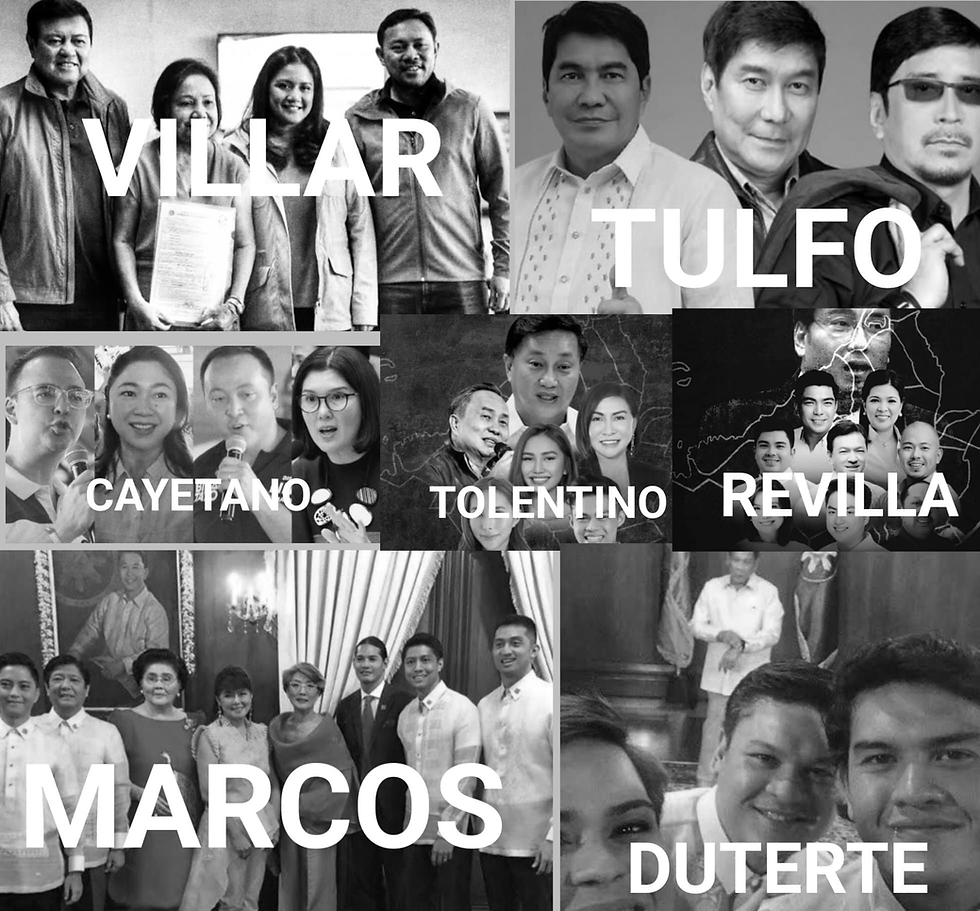
Elite political power captures the country’s economic resources that exacerbate social inequality and poverty in society; political and economic power overlap. The leading political and economic oligarchs include the Marcoses, Dutertes, Romualdezes, Villars, Macapagal-Arroyos, and Aquinos. These powerful clans have deep historical, congressional and regional influences. Some have produced multiple presidents and leveraged generational education, elite marriages, and political machinery.
Across the country, however, the political elite represents a microscopic fraction - less than 1% of the population - traditionally concentrated within approximately 250 interlinked political dynasties.
The elite monopolize politics: nearly 90% of provincial governors and 75% of city mayors. About 55% of all elective positions across district, municipal, and provincial levels are controlled by these same clans.
Political dynasties, through patron-client relations and abuses of power, exhaust resources to establish economic and political dominance, weaken political competition, and undermine political accountability.
In political-economic terms, the society is kept underdeveloped by a patrimonial-oligarchic state where elite families and political dynasties – like birds tearing at their prey - capture economic and institutional power, trapping the country in structural inequality.
The monopoly of political influence brings to heel the concentration of wealth. Along with those who hold no elective posts but otherwise wield transactional influence, the richest 10% control 76% of the country’s total wealth.
Dynasties maintain influence through the "seven Ms" - money, machinery, media, marriage, murder/mayhem, myths, and mergers - combining vast wealth with patronage networks.
Politically dominant, the elite demolish governance institutions and institutional checks on corruption.
That’s why today the Philippines ranks as the third most corrupt country among Southeast Asia’s 11 nations trailing Myanmar and Cambodia, based on the latest Corruption Perception Index (CPI).
The Philippine political system is modeled after US-style democracy – actually, plutocracy - featuring a presidential system, a bicameral legislature, and a separation of powers. This Western framework was grafted onto a deeply embedded feudal and clientelist culture. In practice, local power brokers, patrons, and political dynasties exercise vast influence. This structure produced a personality-centered political party system where politicians prioritize family or factional survival over national policy and party platforms.
The country is “ungovernable” because of its chronic stability issues ensuing from deeply rooted structural flaws. Democracy is only in form without any substance, suffocated by political fragmentation and instability that severely hampers effective governance. Malgovernance has brought the country into regime changes sparked largely by civilian uprisings – the toppling of the Marcos dictatorship in 1986 and the Estrada presidency in January 2001, and the near-ouster of Gloria M. Arroyo in 2005 who faced political crisis over allegations of election fraud.
Malgovernance is a system that dates to colonial years. In the context of public administration, legal systems, and political discourse it is bad governance. The Supreme Court typically evaluates the concept under the terms “evident bad faith” (dolus malus). Under Spanish colonial rule, the elite was the principalia (landowning class) while the American imperial colonizers favored the propertied and educated ilustrados.
The country’s political structure wobbles on an economy gone astray. The economy shifted from agriculture straight to low-value service and remittance-based model, bypassing heavy manufacturing.
Fragmentary land reform and high input costs have left rural food production weak and farmers impoverished. Aggregate GDP expansion (5–7%) largely benefits the top percentile, failing to generate stable, high-paying domestic employment.
Malgovernance – or misgovernance – wastes away the country’s vital interests including achieving sustainable economic development, maintaining national security, upholding territorial integrity, and ensuring social equity.
As outlined by the state, these core priorities are designed to eradicate poverty, build resilient communities, and foster a globally competitive nation. They remain a pipedream. #


Comments