


DYNASTIES MOUNTING IN NUMBER

Updated: 7 minutes ago
Traditional politicians are unaccountable
Issue Analysis No. 09 Bobby M. Tuazon Director for Policy Studies CenPEG
"Without the trust of the people, no government can stand.” The Analects
Political families have grown cumulatively in recent years. The Philippines’ political families - often called "fat dynasties" where multiple relatives hold public office at the same time - grew from 19% to 29% between 1988 and 2019. Political dynasties today dominate a vast majority of elected positions.
Here’s the breakdown in the distribution of dynasties:
Senate: 20 out of 24 senators, or 83%
House of Representatives: 8 in every 10 district representatives
Provinces: 71 out of 82 governors or 87%
Cities: 113 of 149 city mayors or 75%
About 55% of all local elective posts across the provincial, district, and municipal levels are held by members of political clans.
The country’s semi-feudal society gives birth to and perpetuates political families because it intertwines monopolistic land ownership with local state power, allowing elite clans to convert economic dominance into political hegemony. The traditional landlord class and the big comprador bourgeoisie control the primary means of production (mostly land and major commercial resources).
To protect and expand these private interests, the elites occupy government positions, turning public offices into family enterprises. Especially in rural areas, political families become warlords.
Dynastic politics
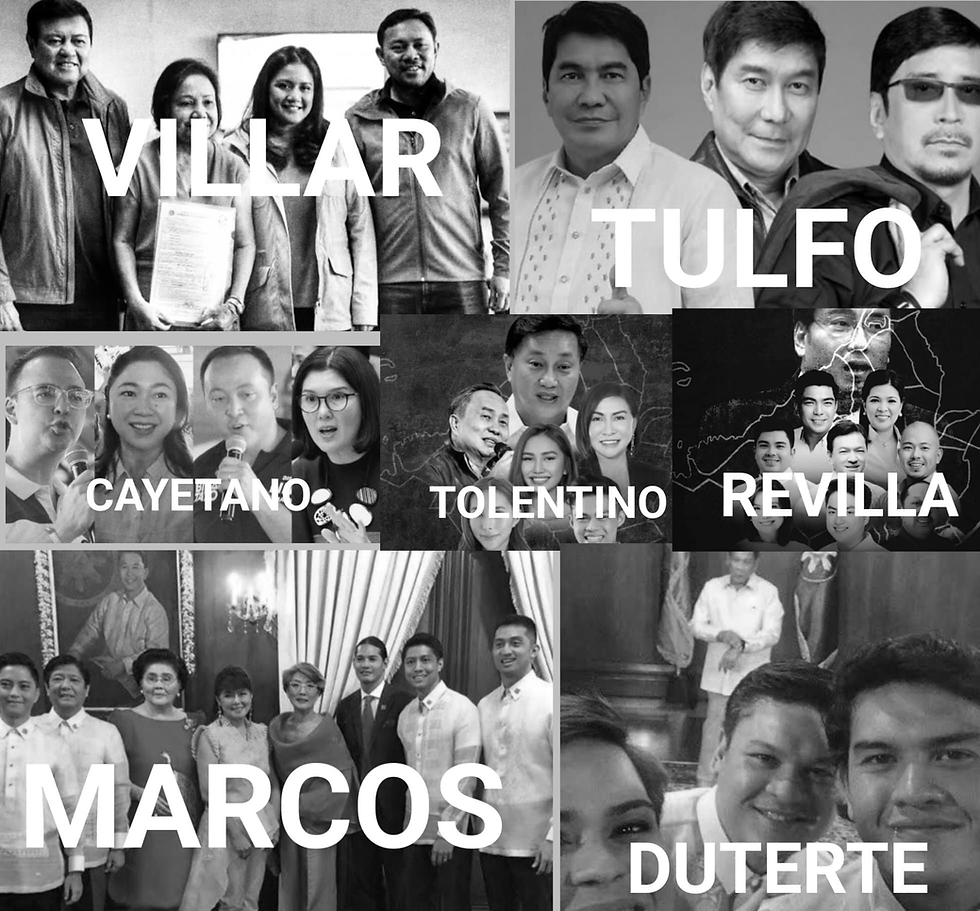
Today, political dynasties are both increasing in number and staying in power much longer across generations. In a political dynasty a single-family controls government positions over many years. Fast consolidating are "fat dynasties" where multiple family members hold different government jobs at the same time – this is palpable under the Marcos dynasty which has produced two presidents with Marcos Jr.’s son in the House of Representatives today.
In the Senate, real estate magnate Manny Villar once served as president; wife Cynthia became senator, and children Mark and Camille are incumbent senators.
Following the 2025 mid-term elections political clans controlled 87% of provinces, 83% of legislative districts, and 75% of cities. Previous reports also show that the share of "fat dynasties" grew from 19% in 1988 to nearly 30% in later election cycles. More relatives run for office together instead of just one member replacing another. Political families do not just stay in their hometowns - they win seats in new provinces and swap high offices among themselves.
In the frontline of the country’s traditional elections stands a powerful dynastic machinery where multiple members of the same family occupy government positions consecutively or simultaneously. Since time immemorial the country’s election has been decided by vote buying, private armies, human or machine-election system allowing national and local dynasties to multiply like worms vertically and horizontally,
Deeply rooted, dynastic rule dates back from pre-colonial times. Leadership among early tribal groups (datus and rajas) relied heavily on kinship ties and bloodlines, establishing an early precedent for family-based authority. The Spanish introduced the principalia - a privileged class of local elites - by granting administrative power and land ownership to favored native leaders, cementing an entrenched ruling class. So-called democratic elections under American colonialism gave the landed elite families the cultural and economic capital needed to transition into institutionalized electoral politics.
The traditional political system has been anchored on patronage and kinship. Absent any ideological platform, a weak party system emerged turning elections into personal contests centered around family names and machinery rather than platform merit.
Most voters look for election platform but find nil if not zero. Leading polling firms like Pulse Asia and Social Weather Stations characterize Philippine elections as primarily personality driven. But localized studies and issue-based surveys indicate a growing demand for platform substance: Recent surveys like those commissioned by the Stratbase Group show vast majorities explicitly demand concrete issues in a candidate's platform. For example, 93% of Filipinos state they look for candidates who include job creation and agricultural development in their platforms.
Are the politicians listening?
Once more, the top political dynasties with powerful national and regional strongholds with interlocking interests include: the Marcoses (Ilocos region); Dutertes (Davao); Villars (Las Piñas), Romualdezes (Leyte); Tulfos (NCR / Partylist); Estrada / Ejercito (Metro Manila / Laguna); Cayetanos (Taguig); Singsons (Ilocos Sur); Binays (Makati City); and Villafuertes (Bicol).
Several of the country's most dominant "fat dynasties" and prominent political families have held power for 50 to 100 years or longer. Among these families are: Marcos family 101 years (1925–present); Sotto Family 119 years (Cebu & national); Fuentebella family 116 years (Camarines Sur); and Espinosa family, Masbate (1934-present); and Singsons (Ilocos region) with the patriarch hailing from Hokien, China in 1823. The Ortega clan, 1901-present (La Union), is recognized as the oldest continuous local political dynasty in the Philippines; and Aquino family (Tarlac) since 1898.
Rivalries for hegemony, not for democracy
Born in the 2022 presidential elections, the Uniteam illusion has since melted away, leaving behind a throne in shambles with the people caught in the crossfire of the ruling elite. Instead of cohesion Philippine governance is in collision today – as it has always been.
This is the dynamics of Philippine politics at least since the 1946 independence. Instead of taking roots, democracy, as the country has been described, keeps on chasing the wind.
Sown by American colonialists at the turn of the 20th century, electoral democracy exists alongside family dynasties that, year in and year out, continue to dominate the system, leaving the electorate with no real choice on whom to vote for to address widespread poverty and the lack of opportunities.
True democracy is "rule by the people" in a system where the people elect leaders through regular, free, fair, and competitive elections.
But there’s the rub: In old times, Greek philosophers viewed democracy with suspicion, while eastern philosophers like Confucius focused on moral meritocracy rather than popular rule. Plato argued that democracy is an inherently flawed and unstable system. Aristotle classified democracy as a perverted or defective form of government.
Instead, Aristotle preferred a mixed constitution called Politeia (constitutional government), which balances democratic elements with meritocracy and the rule of law.
Confucius (551–479 BCE) did not advocate for democracy in the Western sense. He believed instead in a strict hierarchical society governed by virtue, moral capability, and meritocracy. The Chinese guru famously noted that a government requires food, weapons, and the people’s trust. If it must give up one, it should give up weapons first, then food, because "without the trust of the people, no government can stand."
In Philippine realpolitik, the political rift between President Ferdinand R. Marcos Jr. and VP Sara Duterte has been at a great cost to the country impacting governance depriving the people of the delivery of services, protection of human rights, and guaranteeing the security of the people not by the use of coercion but by protecting their rights – food, jobs, and shelter.
Oligarchic rule continues to aggravate a decades-long, institutional crisis.
The socio-economic contour for the Filipino people reveals a mix of incremental progress in food security alongside sharp, immediate challenges in employment and long-standing bottlenecks in affordable housing. While long-term, multi-year food security tracking shows slow improvement, inflation and high prices have caused a recent spike in short-term hunger. Roughly three out of 10 experience food insecurity. Twenty-one (21) percent reported experiencing involuntary hunger especially among lower-income households.
More intractable, the political rift between Marcos Jr. and Duterte has triggered a severe constitutional and institutional crisis, affecting key branches of government and altering national security priorities. The conflict escalated into open legal warfare after the lower House impeached Vice President Sara Duterte over allegations of fund misuse, corruption, and threats against the President. The Senate is currently acting as an impeachment court. How it will settle the issue is anybody’s speculation.
Accountability
In the final analysis, political dynasties in the Philippines create weak or virtually non-existent accountability because power stays inside the same family networks, which breaks the system of checks and balances. Family rule buries democratic oversight.
Dynastic power allows family members to occupy multiple government positions simultaneously or successively—for example, with a parent in the Senate and children serving in the House of Representatives or local government. This concentration of authority creates serious conflicts of interest because relatives are unlikely to investigate, sanction, or hold one another accountable for corruption, abuse of power, or poor governance.
Article II, Section 26 of the 1987 Constitution directs the State to guarantee equal access to opportunities for public service and prohibit political dynasties “as may be defined by law.” For nearly four decades, however, Congress failed to enact the comprehensive legislation necessary to define political dynasties and establish their legal scope, restrictions, and penalties—an inaction closely tied to the fact that many legislators themselves belong to powerful political families.
In its landmark August 26, 2026 ruling, the Supreme Court unanimously declared that this constitutional provision is not merely aspirational but imposes a mandatory duty on Congress to enact an anti-political dynasty law. The Court ruled that Congress’ failure to fulfill this obligation for 39 years constituted grave abuse of discretion and directed it to pass the appropriate law “with utmost urgency” and “at the earliest opportunity.” It clarified that Congress has discretion in defining the scope and coverage of political dynasties, but it has no discretion over whether such a law should be enacted.
Nevertheless, the ruling does not by itself immediately disqualify members of political dynasties from running for or holding public office. The Supreme Court held that, until Congress defines political dynasties and prescribes the consequences through legislation, the Commission on Elections cannot create new grounds for disqualification on its own. Thus, although the decision is a historic step toward constitutional accountability, its practical force ultimately depends on Congress enacting a comprehensive and meaningful law rather than one weakened by exemptions, narrow definitions, or loopholes.
Social and economic costs
Dynastic rule has come at immense political, economic, and social costs to the detriment of the rights of the people. Their systemic and institutional rule has deprived the whole society of economic growth that is otherwise realizable were it not for the power monopoly of political families.
More to the point, long-term rule by political families creates severe political, social, and economic costs that weaken democratic institutions and hinder broad-based development.
Studies correlate heavy dynastic control - especially in resource-rich provinces outside Luzon - with higher poverty rates and skewed wealth distribution.
Moving forward
The country’s political order is anti-people and decadent; how to reform or even replace it is a monumental challenge. #


Comments