


𝗖𝗲𝗻𝗣𝗘𝗚: 𝗗𝗲𝗳𝗲𝗻𝗱 𝘁𝗵𝗲 𝗔𝗿𝗯𝗶𝘁𝗿𝗮𝗹 𝗩𝗶𝗰𝘁𝗼𝗿𝘆 𝗧𝗵𝗿𝗼𝘂𝗴𝗵 𝗮𝗻 𝗜𝗻𝗱𝗲𝗽𝗲𝗻𝗱𝗲𝗻𝘁 𝗙𝗼𝗿𝗲𝗶𝗴𝗻 𝗣𝗼𝗹𝗶𝗰𝘆, 𝗡𝗼𝘁 𝗚𝗿𝗲𝗮𝘁-𝗣𝗼𝘄𝗲𝗿 𝗔𝗹𝗶𝗴𝗻𝗺𝗲𝗻𝘁


The Center for People Empowerment in Governance (CenPEG) joins the Filipino people in commemorating the 10th anniversary of the landmark 2016 Arbitral Award, a historic legal victory that affirmed the Philippines' sovereign rights and maritime entitlements within its Exclusive Economic Zone (EEZ) under the United Nations Convention on the Law of the Sea (UNCLOS).
The ruling remains a powerful affirmation that international law—not the use of force or unilateral assertions—should govern the peaceful resolution of maritime disputes. The ruling remains a significant legal and diplomatic victory for the Filipino people. It clarified that China's expansive "nine-dash line" claim has no legal basis under international law and strengthened the Philippines' legal position in asserting its rights in the West Philippine Sea.
However, CenPEG cautions that this legal victory should not be exploited to justify policies that draw the Philippines deeper into the strategic rivalry between the United States and China.
"The arbitral ruling belongs to the Filipino people. It is neither a diplomatic trophy to be appropriated by Washington nor an excuse for Beijing to ignore international law," said Prof. Roland G. Simbulan, Chair of CenPEG. "The Philippines must reject any attempt by external powers to use our legitimate maritime dispute as a pretext for expanding their military footprint or advancing their geopolitical agenda. Our victory in The Hague should reinforce—not weaken—our constitutional commitment to an independent foreign policy."
Prof. Simbulan stressed that while China must respect the arbitral award and refrain from actions that violate Philippine sovereign rights, the Marcos administration must likewise avoid policies that increase the country's dependence on the United States.
"The continuing expansion of EDCA sites, the growing rotational presence of foreign troops, and the increasing use of Philippine territory for military operations risk transforming our country into a forward base in an escalating U.S.-China confrontation," Simbulan said. "These policies heighten regional tensions and expose Filipinos to dangers that do not serve our national interest."
"The strongest defense of Philippine sovereignty is not military dependence but an independent foreign policy anchored on diplomacy, regional cooperation, self-reliant defense, and strict adherence to international law. We should engage all countries as friends while refusing to become a pawn in great-power competition."
CenPEG reiterated that the 1987 Constitution requires the State to pursue an independent foreign policy in which national sovereignty, territorial integrity, and the welfare of the Filipino people remain paramount.
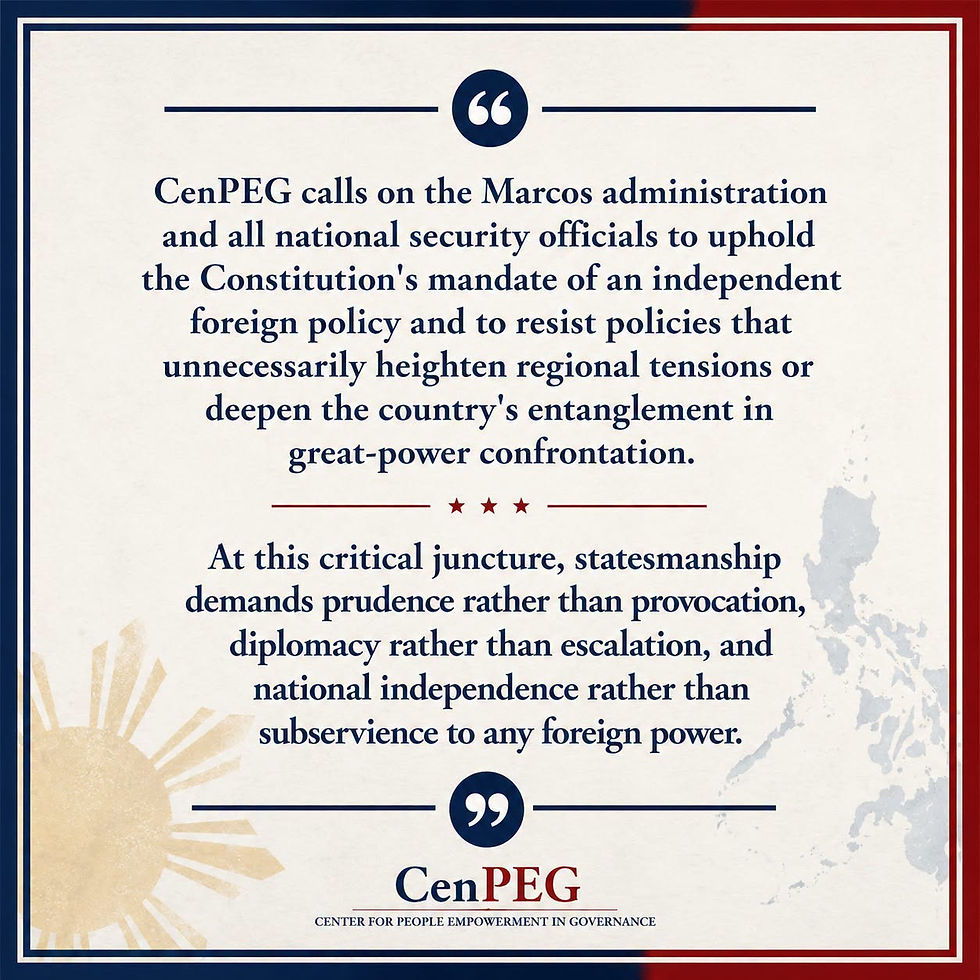
The policy research institution urged the Marcos administration to continue asserting the arbitral ruling through diplomatic engagement, multilateral cooperation, confidence-building measures, and peaceful dialogue while strengthening the country's own maritime and defense capabilities without excessive reliance on any foreign military power.
Ultimately the Philippines must strengthen its economy so that we can build our own credible external defense capability like our ASEAN neighbors, so that we are not held hostage by other big powers which will only compromise our national security as its pawn and forward base.
"As we commemorate this landmark victory, let us remember that genuine sovereignty means not only defending our seas but also preserving our freedom to determine our own destiny," Prof. Simbulan concluded. "The Philippines should be a bridge for peace in the region—not a launching pad for conflict."
CenPEG calls on all Filipinos to uphold the arbitral award, defend the country's sovereign rights in the West Philippine Sea, and remain steadfast in advancing an independent foreign policy that serves only one interest—the national interest of the Filipino people.###


Comments