


AES Watch citizens' poll monitoring center launched
CenPEG.org
May 11, 2013
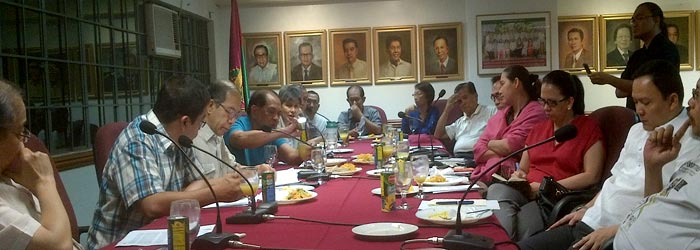
The Automated Election System Watch (AES Watch) and CenPEG, in cooperation with the University of the Philippines' Center for Integrative and Development Studies (CIDS) launched the automated election monitor center for 2013 on April 29 this year as part of a joint election study. It is operational since May 2.
Read more >>>


Monitor research volunteers

AES Watch's Ushahidi monitoring website
PRESS RELEASE
Automated Election System Watch (AES Watch)
May 10, 2013
IT experts: 'Is Comelec fooling us again?'
AES Watch demands full disclosure of deal
IT experts from the Automated Election System Watch (AES Watch) agree: The turnover by the Colorado-based SysTest Labs Inc. (SLI) of the Dominion-owned election source code to Comelec was just for show and is not compliant with the law.
Read more >>>
Citizens against an imperious Comelec
Rene B. Azurin
BusinessWorld,
May 9, 2013
Posted by CenPEG.org
How Brillantes' releasing such source code a mere five days before election day can possibly comply with the explicit provision in the law that this be promptly made available for public review as soon as the technology for the automated polls is selected is probably only explainable by legal luminaries like himself.
Read more >>>
34 concerned citizens, voters, and taxpayers file suit before the UN Human Rights Committee
Former VP Teofisto T. Guingona, Jr. leads Complainants

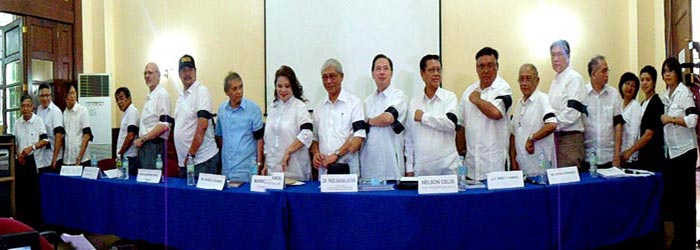
UN Petitioners, joined by AES Watch conveners and members, wear black arm bands symbolizing their protest against violations of voter rights.
On May 3, 2013, 34 concerned citizens, voters, and taxpayers filed a Petition against the Commission on Elections (Comelec) through the Philippine government for violation of citizens' right of suffrage. Violation of Article 25 of the Optional Protocol to the International Covenant on Civil and Political Rights (ICCPR) was cited as the basis for filing the Petition before the UN Human Rights Committee (UNHRC) in Geneva, Switzerland.
Read more >>>
PRESS RELEASE
Center for People Empowerment in Governance (CenPEG)
April 28, 2013
CenPEG: Comelec's non-compliance of automation law poses legal and credibility questions on coming elections
The think tank Center for People Empowerment in Governance (CenPEG) today asked the country's voters and poll watchers to prepare for contingency as the automation system to be used for the May 13 mid-term elections will trigger legal and credibility questions – more critically than in May 2010. CenPEG is a key convener of AES (Automated Election System) Watch which continues to monitor the ill preparedness of Comelec's poll automation project with the contracted foreign technology sales firm, Smartmatic.
Read more >>>
Comelec sued for P490M bidding scam
Posted by CenPEG.org
April 27, 2013
The case, one complainant says, is a reflection of the "dagdag bawas" (vote padding/shaving) similar to the counting of votes but with one main difference - in the costing of supplies involving over hundreds of millions of pesos where the overpricing is always "dagdag" and never "bawas". AIR21Ꞌs bid price for deployment of election paraphernalia was originally only P302M. Mysteriously, long after completion of post qualification proceedings, in another document that is almost identical word-for-word and in appearance to the original document, in exactly the same bid of AIR21 for exactly the same deployment services, the bid price went up by P188M (38.33%) skyrocketing up to a total of P490M. Who did it? For whom? Why?
Read more >>>
Two books on automated elections launched
CenPEG.org
April 12, 2013

Evi Jimenez, extreme left, talks about AES Watch and acknowledges support for the book. Seated (l-r): Gus Lagman, VP Teofisto Guingona Jr., Rene Azurin, and Bobby Tuazon.
The book, Was Your Vote Counted? Unveiling the myths of Philippine automated elections, was launched before an SRO audience on April 10, 2013 at the Ateneo professionals school, Rockwell Center, Makati. Authored jointly by conveners of the Automated Election System Watch (AES Watch), the book was launched back-to-back with columnist Rene B. Azurin's latest book, Hacking Our Democracy, a compilation of his opinion columns on automated elections published by BusinessWorld (BW) daily.
Read more >>>
Supreme Court
High Court unmasks self as pro-oligarch in latest Party-list ruling
By allowing traditional politicians who share the same stage as the economic tycoons themselves to pack the party-list contest with the have-nots, did the Supreme Court think the Davids can slay the Goliaths? The decision is either too much wishful thinking or too much sadism
Read more >>>
It's now definite: Mid-term elections to proceed without source code review
It's now definite: Even without any source code review, the May 13, 2013 automated mid-term elections will proceed.

JCOC acting chair Sen. Alan Peter Cayetano (left row, middle) acknowledges Evita Jimenez, CenPEG executive director, at the committee hearing, Feb. 28, 2013. (CenPEG photo)
Read more >>>
Prepare for contingency, Kontra Daya tells Comelec
CenPEG.org
March 20, 2013

Mother Superior Mary John Mananzan talks about her concerns on the 2013 mid-term elections. With her in the panel are (l-r) Ferdie Gaite of Courage, CenPEG's Bobby Tuazon, and Fr. Joe Dizon. (Photo by Jonathan Sta. Rosa)
The anti-election fraud coalition, Kontra Daya, on March 14, 2013 called on the Commission on Elections (Comelec) to draw up contingency plans including manual counting and to "be ready for the worst case scenario" given the poll automation system's vulnerabilities and problems.
Read more>>>
On the brink of a precipice
By Rene B. Azurin
Strategic Perspective
BusinessWorld
Posted by CenPEG.org
A final question has to be raised: Are all the failures and faults of Comelec mere components of a dastardly plot by a shadowy cabal to electronically control Philippine elections?
Read more >>>
Use facts not gutter language, Brillantes told
CenPEG.org
February 19, 2013
The Automated Election System Watch (AES Watch) today said it refuses to go down the level of arguments with the prominent use of gutter language by the head of a Constitutional body – Comelec Chairman Sixto Brillantes.
Read more >>>
AES Watch gives failing rate to Comelec's poll preparations
CenPEG.org
February 19, 2013

AES Watch STAR Card (index photo): Nelson Celis (3rd from right) explains the STAR Card. (L-R) Dr. Pablo Manalastas, Evi Jimenez (CenPEG executive director), Fr. Joe Dizon (Kontra Daya), Fr. Rex Reyes (NCCP general secretary), former Vice President Teofisto Guingona, CenPEG chair Bien Lumbera, Maricor Akol (TransparentElections.org), Gus Lagman (former Comelec commissioner), and Bobby Tuazon. CenPEG photo
To mark its third anniversary on Feb. 18 this year, the Automated Election System Watch (AES Watch) released its STAR Card rating of the Commission on Elections' (Comelec) election preparations with a 0.29 failure grade.
Read more >>>
Dealing with pirated polls, problematic PCOS (part 1 of 2)
Wednesday, 20 February 2013
By Jose Carlos L. Maningat
Posted by CenPEG.org
There is something terribly wrong when the country's election body continues to downplay concerns over the automated election system (AES) – which exhibited major glitches in 2010 but which will still be used for the May midterm polls. Equally troubling is the poll body's crass treatment of AES critics, accusing them of sabotaging the elections and thus closing rooms for constructive dialogue.
Read more >>>
COMELEC MUST STOP COMMITTING THE SAME MISTAKES; VOTERS' RIGHTS ARE AT STAKE
AES Watch
Feb. 18, 2013
Is the repeated failure to comply with the automation law and the fixation to use the defective Smartmatic-provided system setting the stage for a possible election failure? If this is so, the Comelec has nobody to blame but itself for what are potentially impeachable offenses. It should stop pointing the fingers at the usual suspected culprits like the teachers, poll watchdogs, and the voters themselves.
Read more >>>
AES Watch's STAR Card Rating for Comelec's May 2013 Automated Election Preparations: FAILURE
The STAR Card (System Trustworthiness, Accountability, and Readiness Card) is being issued by AES Watch to comprehensively assess and rate the implementation of the second Automated Election System for the May 13, 2013 mid-term elections by Comelec, Smartmatic-TIM, and other providers.
Read more >>>
Are we ready for 2nd automated polls?
Commentary
By Bobby M. Tuazon
Philippine Daily Inquirer
11:43 pm | Friday, February 1st, 2013
Posted by CenPEG
Citizens' poll watchdogs and major IT groups warn that the Comelec will end up with a pirated technology if it uses Smartmatic's precinct count optical scan (PCOS) voting system.
Read more >>>
Dynastic Hubris
Editorial
Philippine Daily Inquirer
11:50 pm | Friday, February 1st, 2013
Posted by CenPEG
The election season is turning out to be an unprecedented showcase of dynastic hubris, with members of historically well-entrenched political families indicating their intent to seek important posts with hardly any or a minimum of qualifications and track record of public service, or any record, for that matter, of competence and vision.
Read more >>>
AES Watch to Comelec: Prove poll automation is ready in May 2013
With the Smartmatic PCOS, electronic fraud – or cheating by a machine with an erratic counting program inside that people do not see and observe – looms in May 2013 IF safeguards are not strictly followed and errors are not fully corrected in time.
Read more >>>
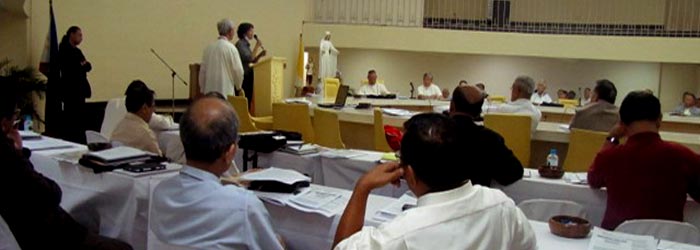
Cebu Archbishop Jose S. Palma, CBCP President, stresses a point during the bishops' plenary session, Jan. 26, 2013, Pope Pius Center, Manila. AES Watch also gave a presentation during the assembly. CenPEG photo)
Bishops fear wholesale cheating with voting system flaws
Election is not a matter of speed but of trustworthiness and honesty. If not properly addressed the present automated election system can lead to wholesale cheating. The integrity of a pillar of our democracy – the election – is at stake. (CBCP Pastoral Statement, Jan. 28, 2013)
Read more >>>
Bishops take Comelec to task
By Rene Azurin
Strategic Perspective
BusinessWorld,
Jan. 31, 2013
Post by CenPEG.org
Comelec has adopted a policy of stonewalling and pretending not to hear what every knowledgeable observer has been saying.
Read more >>>
Comelec scored for zero transparency in poll automation field tests
Why and what is the Comelec so concerned about or afraid of, that it has specifically banned from observing a very critical process of testing the reliability of the PCOS machines in transmitting results? (AES Watch letter to Comelec, Jan. 25, 2013)
Read more >>>
AES Watch to Congress: Move for new poll technology provider
"Has the automated election become a mere money-making business instead of a system that was designed by law to enhance democratic elections?"
Read more >>>
Probe unconscionable prices, Ombudsman and CoA asked
The Ombudsman and Commission on Audit (CoA) are being asked to investigate "unconscionable" pricing of election paraphernalia and services in 2010 and ongoing biddings for the 2013 elections. "Unconscionable," according to CoA, means "overpricing in significant amounts exceeding 100% of the current and prevailing market value." Whistleblower and former Comelec lawyer, Melchor Magdamo, filed a case on Dec. 12, 2012 asking both constitutional bodies to look into unconscionable expenditures involving Comelec, Smartmatic, and other bidders. He has also re-filed a 2010 case of overpricing of ballot secrecy folders involving Comelec executive director Jose Tolentino.
Read more >>>
The U.S. presidential election - through the CenPEG lens
Multi-lingual signages at voting center in Union City. CenPEG photo
Poll inspector’s election paraphernalia. CenPEG photo
Unlike in the Philippines where voting centers are clustered around public schools the voting scheme in California – as elsewhere in the U.S. – was conducted right where communities of voters reside.
Read more >>>
Former VP Guingona – against dynasty. CenPEG photo
Roundtable discussion vs political dynasties held
Oct. 17, 2012
Following the public uproar on the inclusion of more dynastic politicians for the 2013 mid-term elections, a group of good governance advocates, lawyers, and others held a roundtable discussion on political dynasties last Oct. 11, 2012.
Read more >>>

The Sabah Standoff: Peace or War?
Skirmishes between Malaysian police and Muslim Filipinos threaten Mindanao peace talks
CenPEG.org
March 19, 2013

A retired Army colonel (middle, standing) narrates the 1968 Jabidah massacre during the RTD on Sabah crisis. To his right is IIS Prof. Carmen Abubakar; to his left, former Sen. Santatina Rasul. (CenPEG photo)
The Center for People Empowerment in Governance (CenPEG) said on March 18, 2013 that the Sabah standoff pitting the forces of Sulu Royal Army and Malaysian authorities may either lead to a full-blown armed conflict or to peaceful settlement of the century-old territorial dispute.
Read more >>>
CenPEG Fellow in Japan: Philippine struggle for sovereignty
CenPEG.org
December 12, 2012
Roland G. Simbulan
Symposium in Tokyo
Roland G. Simbulan, CenPEG Fellow on foreign policy, spoke in three symposia in Japan from Nov. 22-27, this year in Japan. The well-attended symposia, which also dealt with U.S. bases in Japan, were held in Tokyo and Fukui City.
Read more >>>
Six Centuries of Political Dynasties:
Why the Philippines will forever be ruled by political clans?
Dec. 10, 2012 marked the International Human Rights Day. Before that, the world also remembered the International Anti-Corruption Day. On Dec. 10, the Bicol autonomy movement sponsored a symposium in Naga City on political dynasties. CenPEG Fellow Bobby M. Tuazon talked about "6 Centuries of Political Dynasties" in the Philippines, using this short powerpoint presentation.
PowerPoint Presentation (downloadable)
By Bobby M. Tuazon
CenPEG.org
Dec. 12, 2012
POWER FEUDS IN THE SCS (WPS):
Prospects of Dispute Settlement between Philippines & China
Philippines – A U.S. pawn in its looming clash with China?
This is a PowerPoint Presentation (downloadable) on the current territorial tensions between the Philippines and China, along with other claimants, in the South China Sea (West Philippine Sea). It was presented by the author in a talk on Dec. 4, 2012, University of the Philippines (in Manila) during the Political Science Week.
By Bobby M. Tuazon
Posted by CenPEG.org
Dec. 12, 2012
Demystifying Philippine Statutory Law
Thoughts on Democratic Lawmaking in the 21st Century
The right to information is not just the government's requirement to provide information when asked. Rather, the right to information includes the government furnishing information and giving access as a matter of practice.
By Lance D. Collins, PhD
Posted by CenPEG.org
Dec. 12, 2012
(click here to download)
Read more >>>
World Remembers Road Crash Victims
1.3 million people are killed on the world's roads each year and these deaths and injuries incur an economic cost of $100 billion annually. The Philippines is ranked as among the top 5 countries in terms of road deaths and injuries, with an average of 34 fatal road crashes daily.
By Roland G. Simbulan
CenPEG.org
Dec. 12, 2012
Read more >>>
MODERNIZING DEMOCRACY: THE PHILIPPINE EXPERIENCE
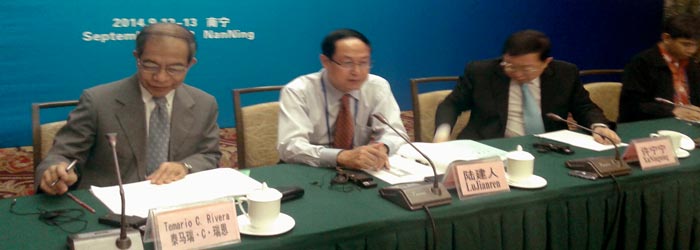
3 CenPEG Fellows hold panel presentation at 9th ICOPHIL in Michigan
By CenPEG.org
Nov. 15, 2012

CenPEG panel presenters (L-R) Lilia Q. Santiago, Bobby Tuazon, Evita Jimenez, and Pablo Manalastas (separate photo). CenPEG photo
Three Fellows of CenPEG called for major electoral reform in the Philippines including an end to political dynasties and a credible and electronic fraud-free 2013 mid-term election.
Read more >>>
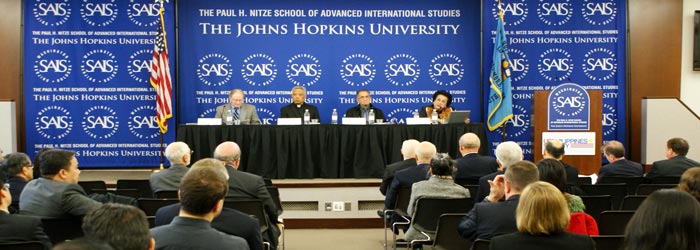
Tuazon delivers his talk. Photo by US-Philippine Society
Institutional issues loom larger than the presidency
CenPEG Fellow Delivers Talk at Johns Hopkins U's SAIS
By CenPEG.org
Nov. 15, 2012
Bobby M. Tuazon, CenPEG's Director for Policy Studies, delivers talk at the Johns Hopkins University's School of Advanced International Studies (SAIS) in Washington, DC, Nov. 1 this year. Tuazon was invited to speak at the Nov. 1 SAIS symposium by the DC-based U.S.-Philippine Society.
Read more >>>

The 8-Day Palestine-Israel War
Hamas headquarters in Gaza hit by Israeli missile Nov. 17, 2012
Nov. 29, 2012 was the UN-declared International Day of Solidarity with the Palestinian People. (The following day, Palestine – whose 8 million people have lived mostly in Palestinian territory occupied by Israel since 1967 – received its non-state member status from the UN General Assembly.) The Philippine Interfaith Solidarity Forum on Palestine was held on Nov. 29 at the National Council of Churches in the Philippines (NCCP), Quezon City, where CenPEG Fellow Bobby M. Tuazon gave a talk. His "8-Day Palestine-Israel War" presentation is downloadable here.
CenPEG.org
Dec. 12, 2012
(click here to download)
'EXTERMINATE ALL THE BRUTES'
"Exterminate all the brutes!" is what colonizers have in mind when the colonized rise in revolt. In the Philippines during the Spanish offensive in Cavite early 1897 the cazadores must have cried "Mata todo!" as they herded hapless men, women and children into the church of Dasmarinas to be burned to death.
By Elmer A. Ordonez
The Other View column,
Manila Times Dec. 1, 2012
Posted by CenPEG.org,
Dec. 12, 2012
Read more >>>
The Imperial 'Pivot' to Asia-Pacific and the New Cold War
By Ninan Koshy
From Central and South Asia to Africa, the Middle East and Asia, the Obama administration is working out its formula for a new American way of war.
American 'Pivot' to Asia Divides the Philippines
By Catherine Traywick, Time, July 23, 2012
"Incidents like the Cardeño case have built up a kind of consciousness and attitude about even a very limited U.S. presence," says Roland Simbulan, a professor at the University of the Philippines.
U.S. eyes return to some Southeast Asia military bases
By Craig Whitlock
Washington Post, June 23 2012
Posted by CenPEG
As the Obama administration revamps its Asian strategy in response to a rising China, the U.S. military is eyeing a return to some familiar bases from its last conflict in the region — the Vietnam War.

ISSUE ANALYSIS No. 01
Series of 2013
March 8, 2013
IN THIS ISSUE:
ISSUE ANALYSIS No. 10
Series of 2012
December 15, 2012
IN THIS ISSUE:
Clan politics vs new politics
ISSUE ANALYSIS No. 09
Series of 2012
The undemocratic and anti-progress hegemony of political dynasties can be effectively challenged by a strong “new politics” movement with a critical mass advocating for an end to dynastic politics.
Election 2013: Horizontal and Vertical Expansion of Political Dynasties
ISSUE ANALYSIS No. 08
Series of 2012
The concentration, expansion, and consolidation of political dynasties over the past 100 years attests to the continuing hegemony of feudal politics, the absence of any form of real democracy, and the continued powerlessness of a vast marginalized majority in the Philippines. Definitely alarming today is the entrenchment of the system of political dynasties on a higher and blatant scale making the fair representation of the large majority of Filipinos even more elusive.
Jesse Robredo and the "Death Zones"
ISSUE ANALYSIS
No. 07
Series of 2012
In this era of government ineptness, neglect, and corruption people search for role models who can show the difference. Robredo became one such model. Amidst the ostentatious and scandal-ridden lifestyle of most public officials, Robredo's was special. Public service, however, is not only about transparency but bringing about lasting social and economic change.
Freedom of Information Issues and Concerns
ISSUE ANALYSIS No. 06
Series of 2012
These are misplaced fears based first of all on a secrecy mindset that deny the fundamental right of the citizenry to knowledge of government transactions, decision-making, and policy. They also ignore the crucial role an informed citizenry can and has played in exposing corruption and bringing its sovereign power to bear on eliminating or at least minimizing it.
Aquino’s ‘Transformational Presidency’: What Change?
ISSUE ANALYSIS No. 05
Series of 2012
Without social consciousness and the will to change, transformational leadership will remain elusive – not under the present state of the nation anyway. From the way he has shown his “leadership” so far, the country has already seen the rest of Aquino’s presidency. Without even being understood by the people, “transformational presidency” has lost its appeal.
ISSUE ANALYSIS No. 04
In this issue:
ISSUE ANALYSIS No. 03
In this issue:
Nowhere to Go: Will Aquino's Anti-Corruption Reform Work?
ISSUE ANALYSIS No. 02
Series of 2012
President Benigno S. Aquino III's much-vaunted anti-corruption program barely scratches the surface of the problem and gives no hint on how he will grapple with its systemic roots. Failing to address or worse abetting the fundamental roots that sustain corruption makes his administration's anti-corruption drive superficial if not a complete sham.
20 Years After: Revisiting the Local Government Code
ISSUE ANALYSIS No. 01
Series of 2012
There should be an end to the fruitless process of reforming laws and crafting development strategies where the dubious intention is in furtherance of elite governance sugar-coated by meaningless concepts of "transparency and accountability", LGU-civil society or "public-private partnership."
Pushing the Case vs Arroyo, Her Chief Justice a Step Further
ISSUE ANALYSIS No. 6
Series of 2011
The signals that the Aquino administration is sending so far are to provide a climate conducive to foreign investment and to project the image of a President determined to pursue reforms particularly in anti-corruption. At the moment though, they do not remove suspicions that what is unfolding only dramatizes a feud between political dynasties and a motive to make the high court more like pro-Aquino than being pro-Arroyo.
FOI and the State's Hegemony of Information
ISSUE ANALYSIS No. 05
Series of 2011
Clearly, the presidential strategy with regard to the FOI bill is to put heavy restrictions so as to make the government in control of public information. Such impediments will favor the state if and when the bill is passed – or would make legislation more protracted so as to stall its final enactment. Either way, the national government wins. But it also signifies a weak regime. Hiding information makes a government unworthy of public trust. Fear of public scrutiny and criticism only means a government unsure of itself.
On the 10th anniversary of 9/11: The War on Terror — Is the World More Secure?
ISSUE ANALYSIS No. 04
Series of 2011
The U.S. is now trapped in a global war of its own making. It will be embroiled in more wars possibly in the next 10-20 years as a result of which it will create more enemies and make the use of force a long-term necessity.
Living in the past: Mishandling the Spratlys territorial row
Issue Analysis No. 03
Series of 2011
Government must abandon the 20th century politics of colonialism and neo-colonialism and begin to act more responsibly with a mature and independent foreign policy.